3 Ways to Find Your Existing AC's Tonnage
Updated July 2026 · by Murugan Vellaichamy · sources checked November 2026
Method 1 — model number
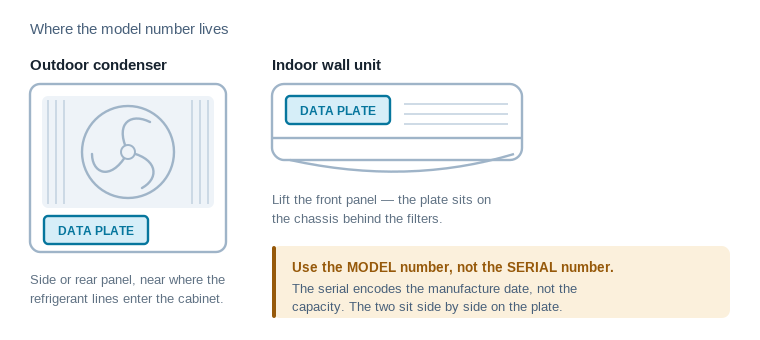
On the outdoor unit's data plate, read the model number (not the serial). A two-digit group from 18, 24, 30, 36, 42, 48, 60 is the capacity in thousands of BTU: GSXN403610AA → 36,000 BTU → 3 tons (Goodman’s own spec sheet). Our decoder applies each manufacturer’s published key for 13 US brands. For Indian units, read the cooling capacity in kW on the BEE star label and divide by 3.517 for tons (12,000 BTU/h = 3.517 kW, NIST SP 811).
Method 2 — data plate ratings
If the plate or spec sheet gives rated cooling capacity in BTU/hr or kW, convert it: 17,580 W of cooling? That's 5 tons (×3.517 kW per ton). kcal/hr figures divide by ~3,024 per ton.
Method 3 — RLA estimation
If the model is illegible, the compressor's RLA (Rated Load Amps) gives a rough bracket: on makers’ spec sheets (Goodman, Amana, American Standard), 3-ton condensers are rated 13.4–16 A and 4-ton units 18.5–19.9 A, roughly 4–6 A per ton. A plate showing RLA 19 falls in the 4-ton bracket on those sheets. Treat this as a last-resort estimate; verify with the manufacturer using the serial number if possible.
More guides
Oversized AC Manual J Explained SEER vs SEER2 vs EER ISEER & BEE Star Ratings Explained Top Floor Under the Roof Window vs Split vs Portable AC AC Wiring Basics US Climate Zones for AC Sizing India AC climate zones How Many BTU per Square Foot? Ceiling Height and AC Sizing 1.5 Ton vs 2 Ton AC Heat Pump Sizing Basics R-22 vs R-410A vs R-454B Server Room Cooling Inverter vs Non-Inverter AC Is Your Electrical Panel Big Enough for a New AC or Heat Pump? Humidity, Latent Load and Why 24°C Can Still Feel Sticky
FAQ
Is the serial number useful for tonnage?
No — serials encode manufacture date and plant, not capacity. Use the model number.
My unit says 36,000 BTU. How many tons is that?
3 tons exactly — divide BTU by 12,000.
Put the numbers to work: AC tonnage calculator · bill calculator · model number decoder.
Sources & standards
Related standards and official programmes, for further reading. Figures on this page come from the sources named in the text or are this site’s own planning estimates; they are not results of these standards’ procedures.
- AHRI Standard 210/240 — Performance Rating of Unitary AC & Heat-Pump Equipment; defines SEER2 / EER2 / HSPF2 (AHRI).
- ANSI/ACCA 3 Manual S — Residential Equipment Selection, matching equipment to the Manual J load (ACCA).
Standards are cited for reference and evolve over time — always follow the edition current in your jurisdiction and a licensed professional’s judgement. Figures on this page are planning estimates, not a substitute for a stamped load calculation or electrical design.
Updated 6 November 2026