AC Model Number → Tonnage Decoder
Your AC's tonnage is coded into the outdoor unit's model number — usually as the capacity in thousands of BTU (24 = 2 tons, 36 = 3 tons). Paste the model number below, or pick your brand for the exact nomenclature.
Capacity code table
| Capacity code | BTU/hr | Tons |
|---|---|---|
| 09 | 9,000 | 0.75 |
| 12 | 12,000 | 1.0 |
| 18 | 18,000 | 1.5 |
| 24 | 24,000 | 2.0 |
| 30 | 30,000 | 2.5 |
| 36 | 36,000 | 3.0 |
| 42 | 42,000 | 3.5 |
| 48 | 48,000 | 4.0 |
| 60 | 60,000 | 5.0 |
Brand-specific decoders
Each page explains exactly where the capacity code sits in that brand's nomenclature, with verified examples.
Goodman
Two digits after the series letters are the capacity code in thousands of BTU.
→USCarrier
Carrier condensers start with 24 (AC) or 25 (heat pump); capacity code follows the series letters.
→USTrane
Digits 7–8 in 4TT model numbers are the BTU code.
→USLennox
Lennox uses a three-digit code after the series (e.g. -036).
→USRheem
RA-series: digits 5–6 are the capacity code.
→USRuud
Same nomenclature as Rheem (sister brand), UA prefix.
→USYork
Capacity code follows the YC-series letter.
→USAmana
Amana shares Goodman nomenclature.
→USBryant
Carrier-family nomenclature; code after series letters.
→USPayne
Carrier-family budget line; PA prefix.
→BOTHDaikin
US DX-series uses BTU codes; Indian FTK-series uses kW-class codes (25=0.8T, 35=1T, 50=1.5T, 60/71=2T).
→USAmerican Standard
Trane sister brand; same digit positions.
→USHeil
ICP family; capacity code embedded after series.
→INVoltas
Indian convention: first two digits = tonnage×10 + star rating digit (185 = 1.5T 5★).
→INLG
12/13 ≈ 1 ton, 18/19 ≈ 1.5 tons, 24 ≈ 2 tons (thousands of BTU).
→INSamsung
AR-series digits are thousands of BTU: 12=1T, 18=1.5T, 24=2T.
→INBlue Star
BTU-code digits inside the model string.
→INHitachi
Indian Hitachi: middle digits encode star+capacity; 18-group = 1.5T, 12-group = 1T, 22/24-group = 2T.
→INPanasonic
CS-series digits are thousands of BTU.
→INO General
Fujitsu General; BTU-code digits after series letters.
→INLloyd
GS/LS prefix + BTU code.
→INWhirlpool
Tonnage usually printed directly in the Indian model name.
→FAQ
Where do I find my AC's model number?
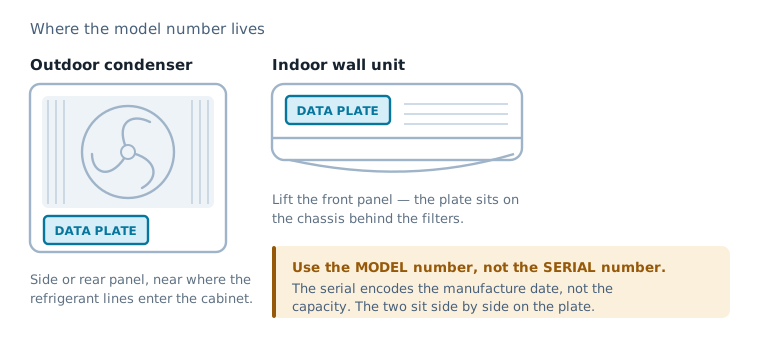
On the data plate (a metal or foil sticker) on the side or back of the outdoor condenser unit. Use the model number, not the serial number — the serial encodes manufacture date, not capacity.
What if my model number isn't recognized?
The decoder falls back to scanning for standalone capacity codes (09, 12, 18, 24, 30, 36, 42, 48, 60) and shows every candidate it finds with a confidence note. If nothing matches, read the rated cooling capacity directly from the data plate — it's always authoritative.
How is tonnage hidden in the model number?
Most manufacturers embed the capacity in thousands of BTU as a two- or three-digit group: 18 = 18,000 BTU = 1.5 tons, 36 = 3 tons, 60 = 5 tons. Indian brands sometimes use kW-class codes or print the tonnage directly. For example, a Goodman GSX140241K contains 24 → 24,000 BTU = 2 tons; scan for the two-digit multiple of 6 or 12. The full mapping is in the capacity code table above.