Heil Model & Serial Number Lookup
Heil is an ICP brand. ICP’s key puts the capacity at characters 5–6: in HSA636GKA, 36 = 36,000 BTU/hr = 3 tons. Paste your model number below.
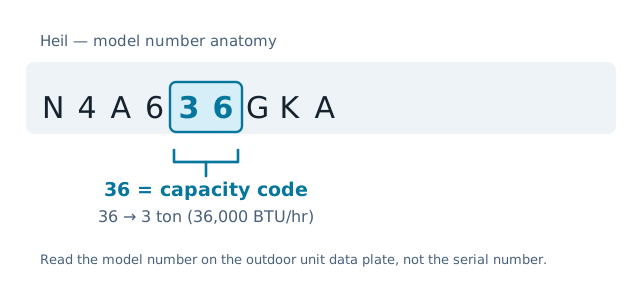
Examples from Heil’s own documents
Each model below is printed in the Heil document linked beside it, with the capacity that document gives. Type any of them into the decoder to see how it is read.
| Model (as printed) | Code | Capacity in the document | Document |
|---|---|---|---|
| HSA636GKA | 36 | 3 tons | Heil HSA6 16 SEER Air Conditioner specifications (421 11 1402 05) |
| NXA648GKA | 48 | 4 tons | Heil NXA6 16 SEER Air Conditioner specifications (421 11 6201 05) |
| N5A5S36AKDWA | 36 | 3 tons | ICP N5A5S Single-Stage AC, R-454B product specifications |
Always confirm against the rated-capacity line on your own unit’s data plate.
Heil capacity codes
Only codes that appear in the Heil documents we checked are listed, and the decoder uses exactly this table.
| Code | Nominal BTU/hr | Tons | Defined in |
|---|---|---|---|
| 18 | 18,000 | 1.5 | ICP Residential Model Nomenclatures — Outdoor Unit Model Number Identification Guide |
| 19 | 18,000 | 1.5 | ICP Residential Model Nomenclatures — Outdoor Unit Model Number Identification Guide |
| 24 | 24,000 | 2 | ICP Residential Model Nomenclatures — Outdoor Unit Model Number Identification Guide |
| 25 | 24,000 | 2 | ICP Residential Model Nomenclatures — Outdoor Unit Model Number Identification Guide |
| 30 | 30,000 | 2.5 | ICP Residential Model Nomenclatures — Outdoor Unit Model Number Identification Guide |
| 31 | 30,000 | 2.5 | ICP Residential Model Nomenclatures — Outdoor Unit Model Number Identification Guide |
| 36 | 36,000 | 3 | ICP Residential Model Nomenclatures — Outdoor Unit Model Number Identification Guide |
| 37 | 36,000 | 3 | ICP Residential Model Nomenclatures — Outdoor Unit Model Number Identification Guide |
| 42 | 42,000 | 3.5 | ICP Residential Model Nomenclatures — Outdoor Unit Model Number Identification Guide |
| 43 | 42,000 | 3.5 | ICP Residential Model Nomenclatures — Outdoor Unit Model Number Identification Guide |
| 48 | 48,000 | 4 | ICP Residential Model Nomenclatures — Outdoor Unit Model Number Identification Guide |
| 49 | 48,000 | 4 | ICP Residential Model Nomenclatures — Outdoor Unit Model Number Identification Guide |
| 60 | 60,000 | 5 | ICP Residential Model Nomenclatures — Outdoor Unit Model Number Identification Guide |
| 61 | 60,000 | 5 | ICP Residential Model Nomenclatures — Outdoor Unit Model Number Identification Guide |
Nominal size is not the same as rated capacity: a unit sold as 4 tons may be rated a little below 48,000 BTU/hr. The rated figure is on the data plate and in the AHRI Directory.
How to read a Heil model number
Heil equipment is made by International Comfort Products (ICP), and ICP publishes one outdoor-unit key for its brands. Reading HSA636GKA:
| Characters | In HSA636GKA | Meaning (ICP key) |
|---|---|---|
| 1 | H | Brand / tier letter (the ICP guide lists C, H or T = Mainline, N = Performance, R = Entry, V = Variable) |
| 2 | S | Refrigerant or feature: 4 = R-410A, C = communicating, S = single-stage communicating, X = R-410A with other features |
| 3 | A | A = air conditioner, H = heat pump |
| 4 | 6 | SEER: 3 = 13 … 9 = 19 |
| 5–6 | 36 | Nominal capacity (see the code table) |
| 7–9 | GKA | Grille/coil, voltage (K = 208/230-1-60), sales code |
Two codes exist for every size: 18 and 19 are both 1½ tons, 60 and 61 are both 5 tons. Watch 13 SEER models: in a model like N4A361… the 3 is the SEER digit and 61 is the size (5 tons), not 36.
R-454B models
Current R-454B units add a letter before the size. In N5A5S36AKDWA, 5 = R-454B, A = air conditioner, 5 = efficiency digit, S, then 36 = 3 tons.
The letter N is shared by several ICP brands, so a model starting with N is not always a Heil unit; the capacity reads the same way.
How old is my Heil? Serial number decoder
Heil serial numbers carry the date the unit was built. Type the serial from the rating plate. The date layout below comes from Heil’s own service documentation.
How Heil serial numbers encode the date
| Position | Meaning | In 0118E00001 |
|---|---|---|
| 1–2 | Week of the year | 01 |
| 3–4 | Year (last two digits) | 18 |
| 5 | Factory code | E |
| 6–10 | Unit sequence number | 00001 |
Example: 0118E00001 = week 1 of 2018, built in Collierville, Tennessee.
Factory codes in the source: E = Collierville, Tennessee; X = Monterrey, Mexico. Other letters exist; we only list the ones the source names.
Covers: current ICP variable-speed outdoor units; older Heil serials use a different, unpublished layout. Two-digit years are read as the most recent matching year.
Where to find the serial: the rating plate, on the back of outdoor AC and heat pump units above the service valves, or inside the front door panel of a furnace.
Sources
- ICP service manual SMICPACHPVSR454-02 (Variable Speed ACs & HPs, R-454B) — page 4, Serial Number Nomenclature (manual covers Heil, Tempstar, Comfortmaker, Arcoaire)
Decoders for other brands
Amana American Standard Blue Star Bryant Carrier Daikin Goodman Hitachi Lennox LG Lloyd O General Panasonic Payne Rheem Ruud Samsung Trane Voltas Whirlpool York
FAQ
Where do I find the model number on a Heil AC?
On the rating plate (data plate) of the outdoor unit — a metal or foil label on a side or back panel. Use the model number for tonnage; the serial number carries the build date (see how old is my unit).
How do I read a Heil AC model number?
Heil uses the ICP key: character 3 is A (air conditioner) or H (heat pump), character 4 is the SEER digit, and characters 5–6 are the nominal capacity. HSA636GKA has 36 = 36,000 BTU/hr = 3 tons. Codes 19, 25, 31, 37, 43, 49 and 61 are alternate codes for the 1.5 to 5 ton sizes.
What tonnage is my Heil AC?
Type the outdoor unit’s model number into the decoder above; it applies the layout from Heil’s own documents. For example, HSA636GKA is listed in Heil HSA6 16 SEER Air Conditioner specifications at 3 tons. If the decoder only gives a generic match, read the rated capacity on the data plate.
How old is my Heil AC?
Read the serial number on the rating plate. On current ICP outdoor units, digits 1-2 are the week of manufacture, digits 3-4 the year, then a factory letter and a 5-digit unit number. For example, 0118E00001 = week 1 of 2018, built in Collierville, Tennessee.
Sources & standards
Everything on this page about Heil model numbers comes from the Heil documents below. Where a manufacturer’s own file is only available from a distributor’s server, the note says so.
- ICP Residential Model Nomenclatures — Outdoor Unit Model Number Identification Guide
- Heil HSA6 16 SEER Air Conditioner specifications (421 11 1402 05)
- Heil NXA6 16 SEER Air Conditioner specifications (421 11 6201 05)
- ICP N5A5S Single-Stage AC, R-454B product specifications (N5A5S-11-02PD)
- AHRI Directory of Certified Product Performance — certified cooling capacity and SEER2/EER2 for US systems (ahridirectory.org).
Tonnage is nominal cooling capacity divided by 12,000 BTU/hr per ton.
Manufacturers change model formats over time. The rated-capacity line on the unit’s data plate is always authoritative; figures here are for identification, not a substitute for a load calculation.
Different brand? Back to the model number lookup. Sizing a replacement? Check what your space really needs with the AC tonnage calculator first — the old unit may have been mis-sized.