Window AC Calculator
ENERGY STAR’s room AC chart starts at 5,000 BTU for 100–150 sq ft, and certified window units go up to 34,100 BTU. Oversizing a window unit is the most common mistake — it cools fast but leaves the room damp.
Load: this site’s planning estimate (not a Manual J). Recommended unit: the smallest size on ENERGY STAR’s room AC chart within 90–115% of the load (ENERGY STAR’s recommended range for single-speed central systems, which this site also uses for room units).
| Recommended unit | — |
| Tonnage equivalent | — |
| ENERGY STAR chart for this room | — |
Picking a window unit that actually fits
Window units come in tight capacity steps (ENERGY STAR’s chart goes 5,000 / 6,000 / 7,000 / 8,000 / 9,000 / 10,000 BTU and up), which makes right-sizing easy — and oversizing tempting. Resist the bigger box: dehumidification needs long run cycles, and an oversized unit leaves a room cold and clammy (short-cycling in miniature).
Check three things besides BTU:
- Chassis width against your window opening.
- Plug & circuit — larger units can need a dedicated circuit or a 230 V outlet. The spec sheet lists the plug type and amps.
- CEER efficiency — a couple of points is real money over a six-month season.
What size room does each BTU rating cool?
ENERGY STAR’s room air conditioner chart, read the other way round: the floor area each capacity is meant for, in a room with 8 ft ceilings. A sunny room, extra people or a kitchen need more capacity, so the same unit covers less floor area there (adjustments below).
| Capacity | Room size (ENERGY STAR) |
|---|---|
| 5,000 BTU | 100–150 sq ft |
| 6,000 BTU | 150–250 sq ft |
| 7,000 BTU | 250–300 sq ft |
| 8,000 BTU | 300–350 sq ft |
| 9,000 BTU | 350–400 sq ft |
| 10,000 BTU | 400–450 sq ft |
| 12,000 BTU | 450–550 sq ft |
| 14,000 BTU | 550–700 sq ft |
| 18,000 BTU | 700–1,000 sq ft |
| 21,000 BTU | 1,000–1,200 sq ft |
| 23,000 BTU | 1,200–1,400 sq ft |
| 24,000 BTU | 1,400–1,500 sq ft |
| 30,000 BTU | 1,500–2,000 sq ft |
| 34,000 BTU | 2,000–2,500 sq ft |
ENERGY STAR adjustments: −10% capacity for a heavily shaded room, +10% for a very sunny one, +600 BTU for each regular occupant beyond two, +4,000 BTU for a kitchen. Source: ENERGY STAR room air conditioners.
When to choose something else
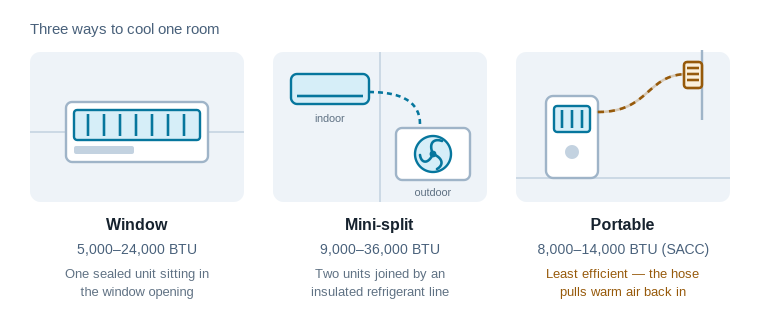
For a large space, compare a mini-split before buying two. For a room with no suitable window, a portable works, but it sits inside the room and draws in warm outdoor air to replace what it exhausts. DOE rates portables by seasonally adjusted cooling capacity (SACC), which accounts for that and is lower than the older figure some boxes still print, so compare portables by SACC.
FAQ
What size window AC for a 10x12 bedroom?
A 10×12 bedroom (120 sq ft) in a moderate climate needs about 5,000–6,000 BTU. ENERGY STAR adds 10% if the room is very sunny.
Is it bad to oversize a window AC?
Yes. An oversized unit cools fast, then short-cycles before it can wring humidity out of the air, leaving the room cold and clammy. Right-size, or size slightly under, for a dry, comfortable room.
What's the largest window AC available?
Certified window units on ENERGY STAR’s list go up to 34,100 BTU; ENERGY STAR’s chart puts 24,000 BTU at 1,400–1,500 sq ft and 34,000 BTU at 2,000–2,500 sq ft. On the certified list, 230 V models start at about 16,000 BTU, and those need a dedicated 240 V (US) circuit rather than a standard wall socket — check before you buy.
Window AC or portable — which cools better?
A window unit vents its heat straight outside. A portable is rated by DOE in SACC (10 CFR 430 Appendix CC), which is lower than its old ASHRAE box rating, so it needs a bigger box number for the same room. See the portable AC calculator.
What size room does a 12,000 BTU air conditioner cool?
About 450–550 sq ft, according to ENERGY STAR’s room AC chart (8 ft ceilings). Take 10% off the capacity for heavy shade, add 10% for a very sunny room, and add 4,000 BTU if it is a kitchen.
What size room does an 8,000 BTU AC cool?
About 300–350 sq ft on ENERGY STAR’s chart. A 10,000 BTU unit covers about 400–450 sq ft and a 6,000 BTU unit about 150–250 sq ft.
How many square feet does a 5,000 BTU air conditioner cool?
About 100–150 sq ft, which is ENERGY STAR’s smallest band: a small bedroom or office.
Method & standards
Room AC capacity is rated under DOE’s test procedure (10 CFR 430 Subpart B, Appendix F); sizing guidance from ENERGY STAR — ENERGY STAR. See our full methodology.
Updated 6 November 2026