Mini-Split Sizing Calculator
Mini-splits come in fixed head sizes — 9,000 / 12,000 / 18,000 / 24,000 / 36,000 BTU. Add each room as a zone: we snap every room to the right head, total the connected load, and suggest the multi-zone condenser range in BTU and tons. Share the plan with a link.
Climate and defaults follow the US/India switch in the header. The share link encodes your zones in the URL — nothing is uploaded. Estimate only; confirm with an installer's load calculation.
| Connected head total | — |
| Calculated load total | — |
| Suggested condenser | — |
How mini-split sizing works
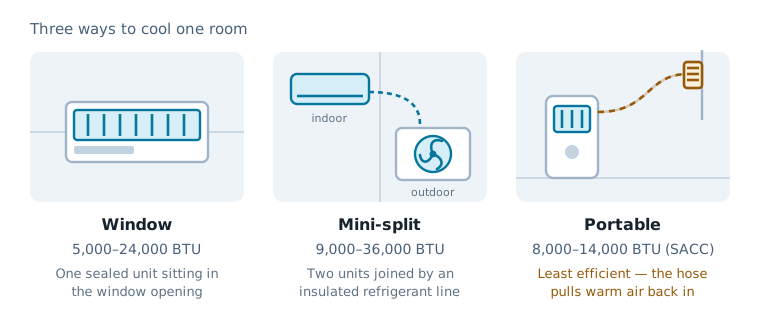
Unlike central AC, a mini-split is sized room by room, then the rooms are matched to one outdoor condenser:
- Size each room’s load the usual way — area, climate, ceiling, sun, occupants.
- Snap to a head size. Indoor heads come in fixed steps: 9,000 / 12,000 / 18,000 / 24,000 / 36,000 BTU. Small rooms still take the 9k minimum.
- Total the connected load across all zones and pick a condenser to match.
Single-zone vs multi-zone
- Single-zone (one head, one condenser) is the most efficient and holds capacity best — ideal for one room or an addition.
- Multi-zone (several heads, one condenser) saves outdoor space and wiring at a small efficiency cost — best when rooms are used at different times.
Matching heads to the condenser
Because rooms rarely peak together, a multi-zone condenser is usually rated at 70–100% of the connected head total (makers publish allowed connection ratios up to ~130%). Example: three heads of 9k + 9k + 12k = 30k connected typically pair with a 24k–30k condenser. Don’t oversize the condenser — at low load an oversized inverter dehumidifies poorly.
FAQ
Can I oversize a mini-split safely?
Inverter mini-splits modulate down, so mild oversizing is more forgiving than with single-stage central AC — but going more than one zone size up still hurts dehumidification and efficiency at low load.
Should the outdoor condenser equal the sum of the indoor heads?
Not necessarily. Because all rooms rarely peak at once, multi-zone condensers are commonly rated at 70–100% of the connected head total (manufacturers publish allowed connection ratios up to 130%). A 9k+9k+12k head set (30k connected) typically pairs with a 24k–30k condenser.
What sizes do mini-split heads come in?
Standard indoor head sizes are 9,000, 12,000, 18,000, 24,000 and 36,000 BTU/hr. Each room's load is snapped to the right head, and very small rooms still take the 9k minimum.
Is a multi-zone mini-split as efficient as single-zone?
Slightly less. A one-to-one (single-zone) system is the most efficient and holds capacity best; a multi-zone condenser serving several heads carries some penalty and can struggle at very low loads if oversized. Match the condenser to the connected head total (commonly 70–100% of it) rather than over-buying.
Do mini-splits work for heating too?
Most modern mini-splits are heat pumps, so the same system heats in winter by running in reverse. Cold-climate models hold useful output well below freezing. Size on the cooling load first, then check the heating capacity at your winter design temperature — see heat pump sizing basics.