Lloyd Model Number Tonnage Lookup
GS/LS prefix + BTU code. Paste your model number for an instant decode.
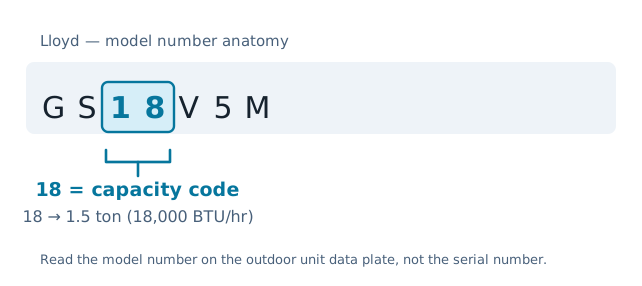
Verified examples
- GS18V5M = 1.5 tons
Always confirm against the data plate's rated capacity line — model ranges occasionally reuse digits for non-capacity codes, and the plate is authoritative.
Capacity code table
| Capacity code | BTU/hr | Tons |
|---|---|---|
| 09 | 9,000 | 0.75 |
| 12 | 12,000 | 1.0 |
| 18 | 18,000 | 1.5 |
| 24 | 24,000 | 2.0 |
| 30 | 30,000 | 2.5 |
| 36 | 36,000 | 3.0 |
| 42 | 42,000 | 3.5 |
| 48 | 48,000 | 4.0 |
| 60 | 60,000 | 5.0 |
Decoders for other brands
Amana American Standard Blue Star Bryant Carrier Daikin Goodman Heil Hitachi Lennox LG O General Panasonic Payne Rheem Ruud Samsung Trane Voltas Whirlpool York
FAQ
Where do I find the model number on a Lloyd AC?
On the data plate — a metal or foil sticker on the side or back of the outdoor unit (or behind the front panel on indoor split units). Use the model number, not the serial number, which encodes the manufacture date rather than capacity.
How do I read a Lloyd AC model number?
GS/LS prefix + BTU code. Divide the BTU code by 12 to get tons.
What tonnage is my Lloyd AC?
Paste the model number from the outdoor unit's data plate into the decoder above — it applies Lloyd's nomenclature automatically. Example: GS18V5M = 1.5 tons.
Lloyd model formats & series
Lloyd (a Havells enterprise) carries the capacity as a two-digit code just after the category prefix. Its Indian shorthand keys (10, 12, 15, 20) map to nominal tonnage on their own scale.
Modern inverter split nomenclature
Current models such as GLS15I36WSEL or GLS12I5FI begin with GLS (high-efficiency wall split). The digits at positions 4–5 are the size: GLS15 → 1.5 tons, GLS12 → 1.2 tons.
Alternate / window AC platforms
Window units switch the prefix to GLW (e.g. GLW18I36WEM) but keep the same parsing rule; the decoder slices the two-digit code after the category prefix to read the tonnage.
The decoder above applies this nomenclature automatically. Capacity codes are nominal — always confirm against the rated-capacity line on the unit’s data plate.
Sources & standards
Capacity decoding on this page follows Lloyd’s published model-number nomenclature. To confirm a unit’s actual rated capacity and efficiency, cross-check the authoritative references below.
- Lloyd product data & model nomenclature — Lloyd (Havells India) publishes the model-number format and rated capacities in its product data and specification sheets (havells.com/lloyd — split-AC (GLS/GLW) specifications).
- BEE Star Label for Room Air Conditioners — the rated cooling capacity (in W and BTU/hr) and ISEER printed on the mandatory energy label (BEE Star Label).
- IS 1391 (Parts 1 & 2) — Room Air Conditioners: performance and test methods, incl. rated-capacity declaration (Bureau of Indian Standards — IS 1391 (Part 2) product manual, PDF).
Tonnage is derived from nominal cooling capacity: 1 ton = 12,000 BTU/hr ≈ 3.5 kW. Indian shorthand codes (e.g. 12, 18, 24) and metric kW classes both map to these nominal tonnages.
Model-number conventions and standards evolve, and manufacturers occasionally reuse digits for non-capacity codes — the rated-capacity line on the unit’s data plate is always authoritative. Figures here are for identification and planning, not a substitute for a professional load calculation.
Different brand? Back to the full 22-brand decoder. Sizing a replacement? Check what your space really needs with the AC tonnage calculator first — the old unit may have been mis-sized.