Bryant Model Number Tonnage Lookup
Carrier-family nomenclature; code after series letters. Paste your model number for an instant decode.
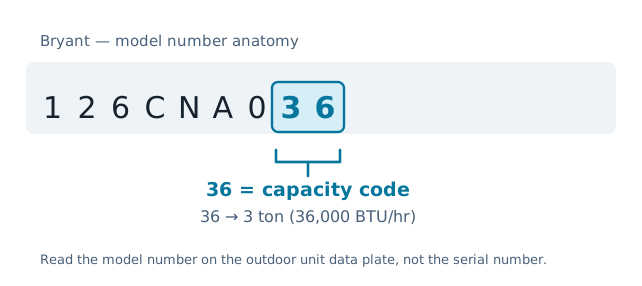
Verified examples
- 126CNA036 = 3.0 tons
Always confirm against the data plate's rated capacity line — model ranges occasionally reuse digits for non-capacity codes, and the plate is authoritative.
Capacity code table
| Capacity code | BTU/hr | Tons |
|---|---|---|
| 09 | 9,000 | 0.75 |
| 12 | 12,000 | 1.0 |
| 18 | 18,000 | 1.5 |
| 24 | 24,000 | 2.0 |
| 30 | 30,000 | 2.5 |
| 36 | 36,000 | 3.0 |
| 42 | 42,000 | 3.5 |
| 48 | 48,000 | 4.0 |
| 60 | 60,000 | 5.0 |
Decoders for other brands
Amana American Standard Blue Star Carrier Daikin Goodman Heil Hitachi Lennox LG Lloyd O General Panasonic Payne Rheem Ruud Samsung Trane Voltas Whirlpool York
FAQ
Where do I find the model number on a Bryant AC?
On the data plate — a metal or foil sticker on the side or back of the outdoor unit (or behind the front panel on indoor split units). Use the model number, not the serial number, which encodes the manufacture date rather than capacity.
How do I read a Bryant AC model number?
Carrier-family nomenclature; code after series letters. Divide the BTU code by 12 to get tons.
What tonnage is my Bryant AC?
Paste the model number from the outdoor unit's data plate into the decoder above — it applies Bryant's nomenclature automatically. Example: 126CNA036 = 3.0 tons.
Bryant model formats & series
Bryant shares production with Carrier under Carrier Global and packages capacity as a two-digit multiple of 12,000 BTU/hr.
Modern multi-digit identifiers
Modern 12-character strings begin with a numeric tier — 113/114/116 are Legacy/Preferred single-speed units, while 180/186 are high-efficiency Evolution inverters. Digit 4 sets the system: C or A is a central air conditioner, H or P a heat pump. The capacity sits in the size window (e.g. 114CNA036 → 36 → 3.0 tons).
Classic / legacy layouts
Older Bryant setups trace to classic Carrier formats beginning with 38 or 561 and carry a zero-padded three-digit capacity (38BYG024 → 024 → 2.0 tons).
The decoder above applies this nomenclature automatically. Capacity codes are nominal — always confirm against the rated-capacity line on the unit’s data plate.
Sources & standards
Capacity decoding on this page follows Bryant’s published model-number nomenclature. To confirm a unit’s actual rated capacity and efficiency, cross-check the authoritative references below.
- Bryant product data & model nomenclature — Bryant (Carrier Global) publishes the model-number format and rated capacities in its product data and specification sheets (bryant.com — product document search).
- AHRI Directory of Certified Product Performance — independently certified cooling capacity, SEER2/EER2 and matched-system ratings for US equipment (ahridirectory.org).
- ANSI/AHRI Standard 210/240 — Performance Rating of Unitary Air-conditioning & Air-source Heat Pump Equipment (systems under 65,000 BTU/hr), the basis for US rated capacity (AHRI 210/240).
Tonnage is derived from nominal cooling capacity: 1 ton of refrigeration = 12,000 BTU/hr.
Model-number conventions and standards evolve, and manufacturers occasionally reuse digits for non-capacity codes — the rated-capacity line on the unit’s data plate is always authoritative. Figures here are for identification and planning, not a substitute for a professional load calculation.
Different brand? Back to the full 22-brand decoder. Sizing a replacement? Check what your space really needs with the AC tonnage calculator first — the old unit may have been mis-sized.