Window vs Split vs Portable AC: Real Cooling Compared
Updated July 2026 · by Murugan Vellaichamy · sources checked November 2026
The portable AC problem
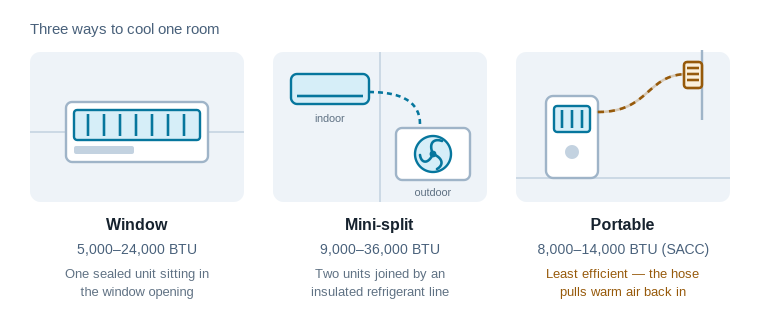
A portable unit sits entirely inside the room: its case heat stays indoors and its single exhaust hose creates negative pressure that pulls warm outside air in through every gap. The DOE's SACC test (10 CFR 430, Appendix CC) accounts for this. Size portables with the SACC calculator, not the box number.
Window and split strengths
Window units put the hot side outside, scoring honest efficiency at low cost — the right answer for renters and single rooms where installation is allowed. Splits put the compressor in a separate outdoor unit, which needs a wall penetration for the refrigerant lines.
When a portable makes sense
Choose a portable only when nothing can be mounted — and buy by SACC.
More guides
Oversized AC Manual J Explained SEER vs SEER2 vs EER ISEER & BEE Star Ratings Explained Top Floor Under the Roof 3 Ways to Find Your Existing AC's Tonnage AC Wiring Basics US Climate Zones for AC Sizing India AC climate zones How Many BTU per Square Foot? Ceiling Height and AC Sizing 1.5 Ton vs 2 Ton AC Heat Pump Sizing Basics R-22 vs R-410A vs R-454B Server Room Cooling Inverter vs Non-Inverter AC Is Your Electrical Panel Big Enough for a New AC or Heat Pump? Humidity, Latent Load and Why 24°C Can Still Feel Sticky
FAQ
Why does my portable AC barely cool?
Most likely it was sized by the ASHRAE label. Check the SACC rating on the spec sheet or the yellow EnergyGuide tag — that's its DOE-rated delivered cooling, and it is lower than the headline figure.
Are dual-hose portables better?
The second hose supplies outdoor air for condenser cooling, so the unit draws less room air out of the house. Compare models by their SACC ratings.
Put the numbers to work: AC tonnage calculator · bill calculator · model number decoder.
Sources & standards
Related standards and official programmes, for further reading. Figures on this page come from the sources named in the text or are this site’s own planning estimates; they are not results of these standards’ procedures.
- U.S. DOE portable-AC test procedure — SACC (Seasonally Adjusted Cooling Capacity), 10 CFR Part 430 (Dept. of Energy).
- ENERGY STAR — efficiency criteria and right-sizing guidance (EPA / DOE).
- AHRI Standard 210/240 — Performance Rating of Unitary AC & Heat-Pump Equipment; defines SEER2 / EER2 / HSPF2 (AHRI).
Standards are cited for reference and evolve over time — always follow the edition current in your jurisdiction and a licensed professional’s judgement. Figures on this page are planning estimates, not a substitute for a stamped load calculation or electrical design.
Updated 6 November 2026